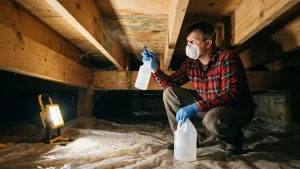
If you’re wondering, “Is mold under flooring dangerous?” Yes, it is. It releases airborne spores that trigger allergies, asthma, and breathing issues (especially for kids, seniors, and immunocompromised people), while quietly rotting and warping subfloors and joists. Watch for musty odors, soft or uneven floorboards, and discolored wood as early warning signs.
Out of 100 NYC floors we’ve tested for mold, 20% tested positive. If you’re located in NYC and worried about mold under your floors, schedule mold inspection and testing services before things get worse and more costly.
Why Is Mold Under Flooring Dangerous?
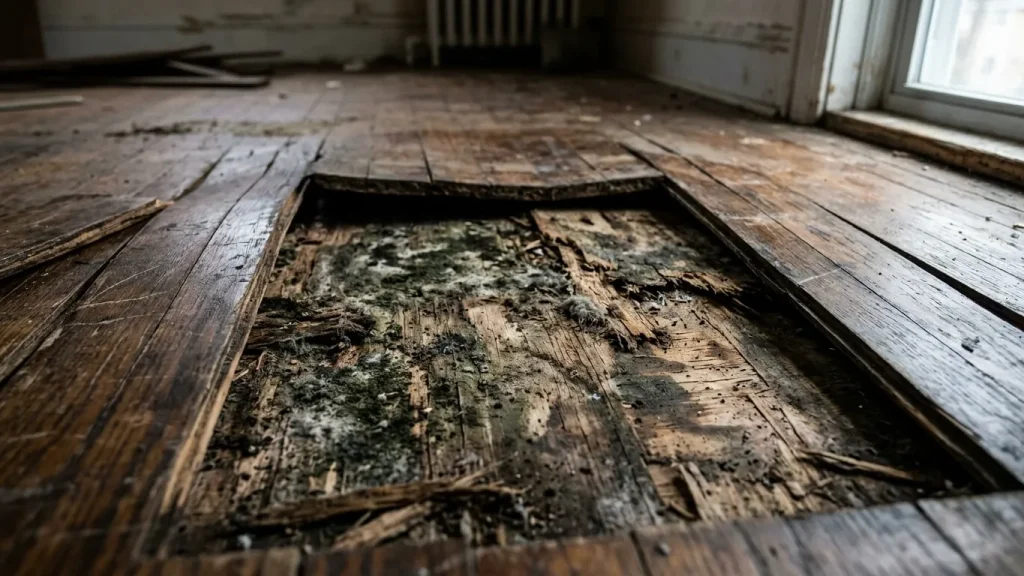
Moisture reaches a subfloor in more ways than one. Indoor humidity alone can do it, with no leak involved, and mold after water damage can begin within 48 hours. Left alone under a floor, a damp patch turns into a mold removal job that reaches the subfloor and the joists beneath it.
Mold sealed between the covering and the subfloor also never dries out and never shows itself. It can grow for months before anyone realizes, and the harm runs in two directions, to the people breathing the air above it and to the wood holding the floor up.
Health Effects of Mold Trapped Under Your Floors
Mold under the floor does not need to be visible to affect the air upstairs. As colonies grow, they release spores and microbial compounds that travel up through seams, gaps, and HVAC systems into the rooms you actually use. That is why a musty smell with no visible source is worth taking seriously, since the odor itself is a byproduct of mold digesting the material it grows on.
Health effects vary from person to person. According to the CDC, damp and moldy environments can cause:
- A stuffy nose
- Sore throat
- Coughing
- Wheezing
- Burning eyes
- Skin rash
- People with asthma or mold allergies may have severe reactions
Infants, older adults, and anyone with a weakened immune system or chronic lung condition face the highest risk, since mold’s health effects depend as much on who is breathing it as on how much is there. A healthy adult may notice only a lingering cough or fatigue, but the exposure is real whether symptoms show up right away or not.
Structural Damage to Your Subfloor and Property Value
Mold digests the wood it grows on, and under flooring, that means the subfloor, the joists, and the framing that hold everything level. This second danger is slower and more expensive than the health risk, and it moves through three rough stages, with the cost of fixing it climbing at each one.
| Stage | What Is Happening | What You Would Notice |
|---|---|---|
| Stage 1 | Surface growth on the underside of flooring or subfloor | Nothing yet. The damage is cosmetic and reversible |
| Stage 2 | Mold penetrates the wood fibers of planks and subfloor panels | Warping, cupping, or a soft, spongy feel underfoot |
| Stage 3 | Decay reaches joists and support beams | Sagging, soft spots, and load-bearing weakness |
Property value takes a hit well before collapse becomes a concern, since sellers must disclose known mold and buyers read an active moisture problem as a reason to renegotiate.
Why Mold Grows Under Flooring
Mold needs moisture, something organic to feed on, and warmth. A floor assembly supplies all three and then traps them, because the covering sits tight against the subfloor with almost no airflow underneath. Water that reaches that layer has nowhere to go. It gets there in ordinary ways:
- Plumbing leaks: A supply line weeping behind a wall or a dishwasher losing a cup a day for months.
- Water dried from the top only: A spill or flood cleaned on the surface while the subfloor stayed soaked.
- Concrete slab vapor: Moisture wicking upward through a slab with no leak at all, common in Brooklyn brownstones and ground-floor apartments.
- Indoor humidity: Damp air settling in basements and lower levels, year-round in older NYC and Northern New Jersey buildings.
- Routine cleaning: Water driven into flooring seams by wet mopping.
The material on top decides how fast trouble builds. Hardwood and laminate swell and feed mold once water reaches their fibers; carpet holds moisture against the subfloor like a sponge; and vinyl and tile shed water on top while sealing it underneath, so mold under vinyl flooring can spread for months while the surface looks clean.
The EPA advises drying wet building materials within 24 to 48 hours to prevent mold, and under a floor, that window is easy to miss because you cannot see what stayed wet.
How to Tell If Mold Is Hiding Under Your Floors
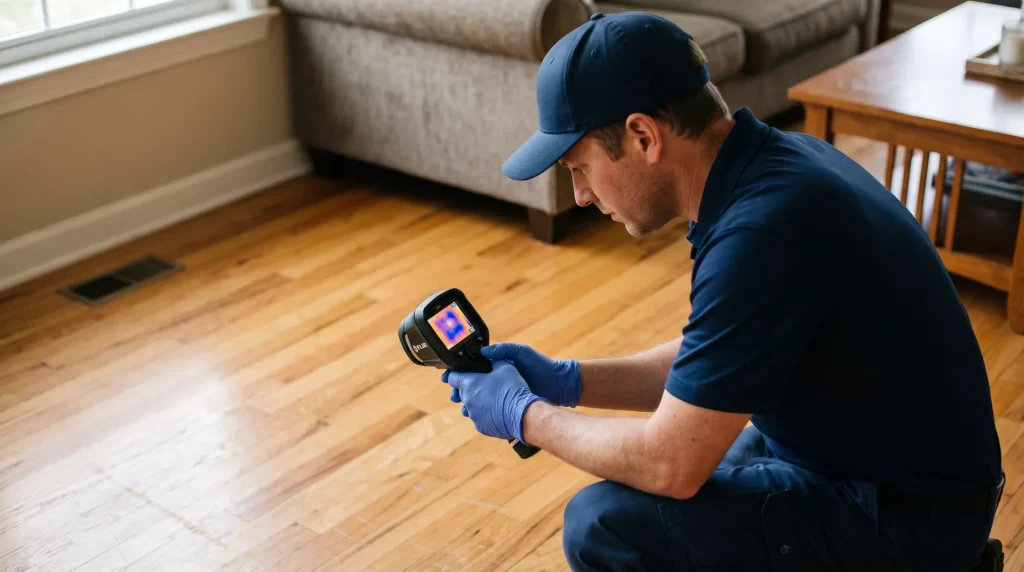
Hidden mold under a floor rarely announces itself, so the signs you can catch are indirect rather than obvious. Nothing on the surface changes, the growth sits in a cavity nobody opens, and the first real evidence is usually something you smell or feel rather than see. In a spare room or a rarely used basement, the gap between the start of the growth and the moment anyone notices can run for months.
A few warning signs are worth watching for:
- Musty odor: A persistent damp or earthy smell that cleaning does not fix, strongest near the floor.
- Soft or spongy spots: Flooring that gives or feels bouncy underfoot, a sign moisture has reached the subfloor.
- Discoloration at the edges: Dark patches or staining near baseboards and along flooring seams.
- Symptoms that ease when you leave: Congestion or headaches that improve away from home and return when you get back.
- A history of water: Any past leak, flood, or stretch of high indoor humidity in that part of the house.
A cheap hygrometer helps you catch the underlying cause. If indoor humidity on a lower level sits above 60 percent for days at a time, conditions already favor growth under the floor. None of these signs confirms mold on its own, and none rules it out.
Tools like thermal imaging and moisture meters help find hidden mold without tearing up a floor, and that is where a professional inspection comes in.
What to Do If You Find Mold Under Your Flooring
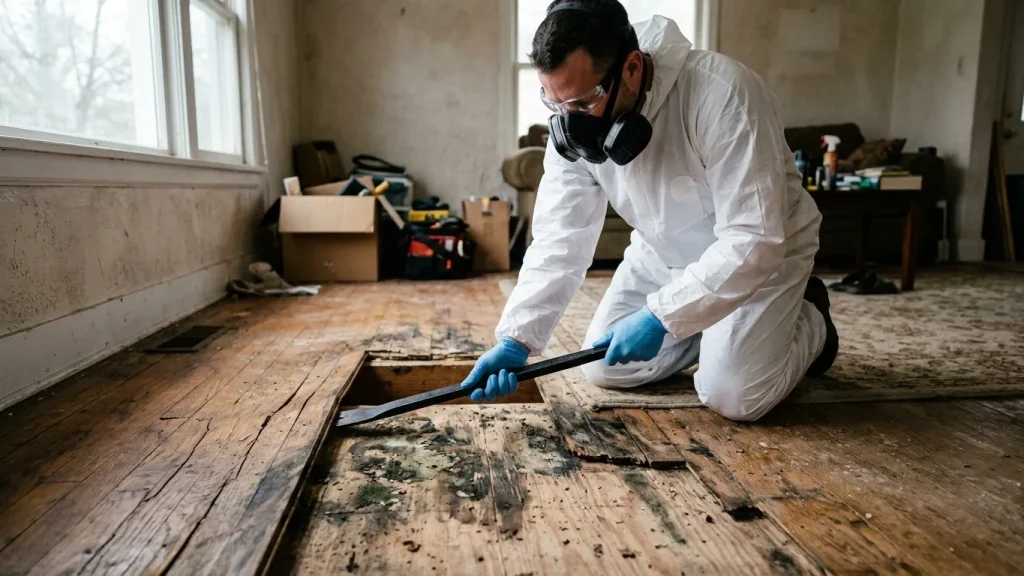
Finding mold under a floor is not automatically a demolition project, but the steps matter, and their order matters more.
- Stop the moisture first: No treatment holds if the water source keeps feeding the growth. Find and fix the leak, or correct the humidity, before anything else.
- Judge the size honestly: Surface mold under about 10 square feet on a hard, non-porous material can often be handled by a homeowner with proper protection. Anything larger, or anything on porous material, is a job for a certified mold remediator.
- Match the method to the material: Hardwood, laminate, carpet, and subfloor hold mold deep in their fibers where surface cleaners cannot reach. Scrubbing the top spreads spores and leaves the roots, so porous flooring calls for professional mold remediation.
- Document before you disturb anything: Photograph the damage, note the moisture readings, and keep the written report Prime Aire provides. That record is what an insurance claim rests on.
- Monitor after the work is done: Keep indoor humidity below 50 percent and recheck the area within 48 hours of any future leak.
Bleach deserves a specific warning. It removes surface stains on porous material without killing the mold rooted underneath, which is why it often looks like a fix and then fails.
How to Keep Mold From Coming Back
Mold that returns rarely comes back because the treatment was weak. It comes back because the moisture source was never fully solved. A dehumidifier holding humidity under 50 percent, vapor barriers over concrete, real ventilation in crawl spaces, and a quick look under the floor after any plumbing problem do more to prevent a repeat than any product applied to the mold itself.
In older or high-humidity NYC homes, an annual inspection catches problems while they’re still cheap to fix.
Schedule a Professional Mold Inspection in NYC Today
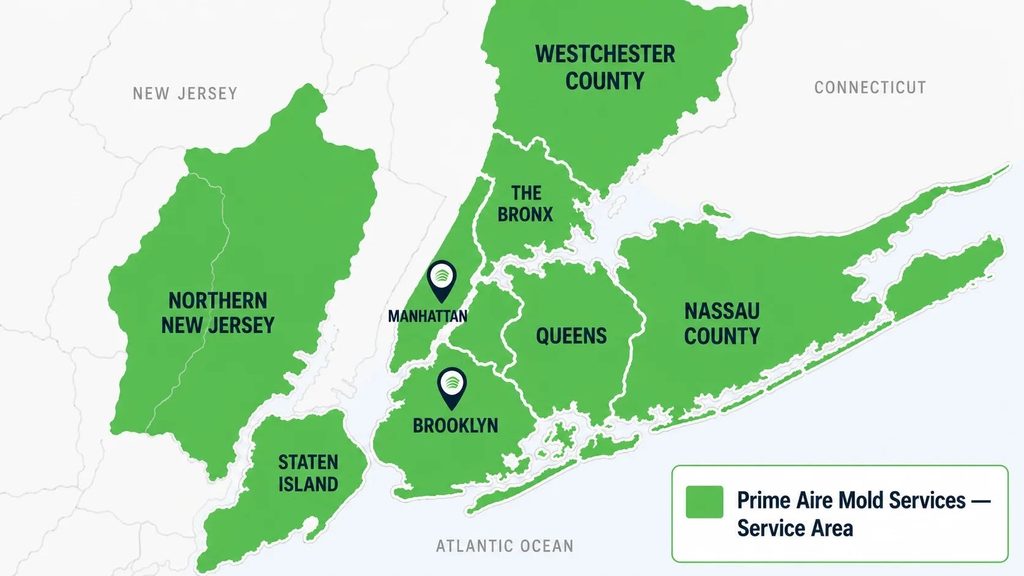
If you want a clear read on what is actually happening under your floor, Prime Aire Mold Services is a New York State-licensed mold company working across the five boroughs, Westchester, Nassau County, and Northern New Jersey. We trace the moisture source, document what we find, and tell you what the situation actually requires, including when that turns out to be less work than you expected.
Here’s why NYC chooses Prime Aire:
- 20+ years in the industry
- 8,000+ completed projects
- 95% first-pass clearance rate
- IICRC-certified technicians
- EPA-licensed & certified technicians
- NYS Licensed Home Inspector on staff
- 90-day satisfaction warranty
- Thermal imaging included at no charge
- Transparent, itemized reporting included
FAQs
Here are answers to frequently asked questions about mold under flooring.
Does the Mold Have to Be Black to Be Dangerous?
Mold doesn’t have to be black to be dangerous; many green, white, pink, or gray molds can also pose health risks.
Is Mold Under Vinyl Flooring Dangerous?
It can be, and it is easy to miss. Vinyl sheds water on top but seals moisture underneath, so growth can spread across the subfloor while the surface still looks clean. A soft feel or a musty smell is often the only clue.
How Long Can Mold Lie Dormant Under a Floor?
Drying a floor out does not kill what is growing under it. Mold goes inactive when the moisture runs out and can stay that way for months, then start again within a day or two of the next leak or humid stretch. A floor that seemed fine for a year can be active again after one plumbing problem.
How Much Does It Cost to Remove Mold Under Flooring?
Mold removal under flooring typically costs $10 to $30 per square foot, depending on job size and severity. A contained area caught early sits at the low end, while pulling and replacing subfloor or framing pushes a job toward the top of the range. A certified assessment prices the real scope before any work starts.
Does Homeowners Insurance Cover Mold Under Flooring?
Sometimes. Mold from a sudden covered event like a burst pipe is more likely to qualify, while mold from a slow, unnoticed leak is often excluded as maintenance. Document the damage before remediation to give your claim the best chance.