
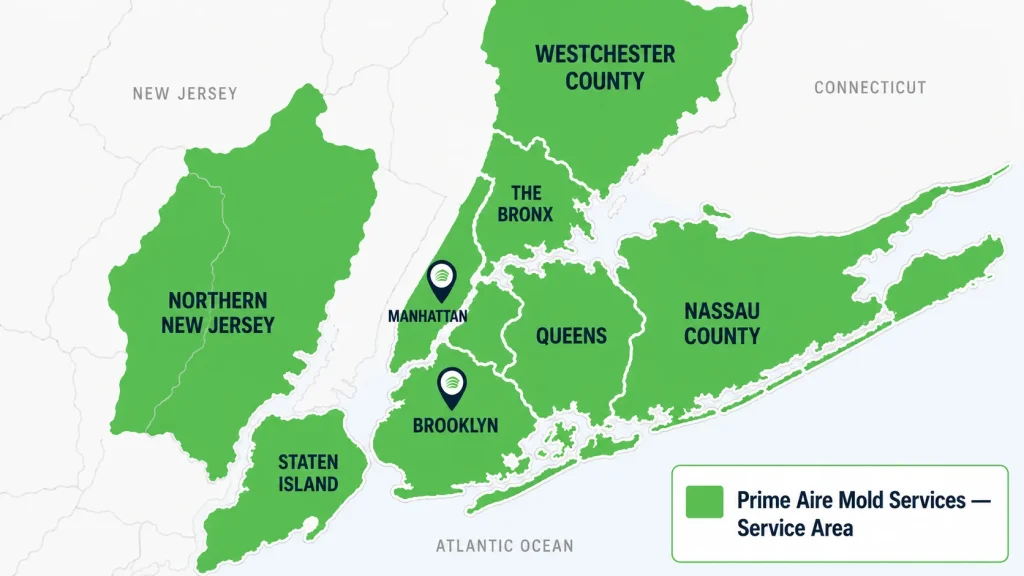
Commercial mold remediation in NYC removes mold safely, eliminates the moisture source, and confirms the space is clear, keeping your business operational. At Prime Aire Mold Services, we serve commercial properties across NYC and Northern New Jersey. With 22+ years of experience and 8,000+ completed projects, we handle mold at scale with minimal disruption.
Discovered mold in your commercial property? Don’t try to handle it yourself. The EPA advises that mold contamination exceeding 10 square feet should be handled by a trained professional rather than DIY cleanup.
Mold remediation follows a structured, step-by-step process:
Assessment and Moisture Identification
Containment and Air Control
Removal and Cleaning
Drying and Verification
What To Do
What Not To Do
Mold is a naturally occurring organism that grows wherever moisture and organic material are present, and while some types are more hazardous than others, all mold growth in a commercial space should be treated as a signal of an underlying moisture problem; the scale is larger, and the consequences are greater.
Mold often grows behind walls and inside ceiling and floor cavities long before it’s detected. By the time you notice an odor, it’s likely been growing for a while and spreading daily. If you suspect indoor mold, the time to act is now.

Here’s what our customers say.

Mold remediation timelines vary based on severity and scale. Here is a realistic range:
| Scope of Mold Issue | Estimated Timeline |
| Small isolated area (under 100 sq ft) | 1–3 days |
| Medium contamination (single room or zone) | 3–7 days |
| Large-scale or multi-floor contamination | 2–4 weeks |
| HVAC system involvement | Add 3–5 additional days |
NYC mold remediation typically costs $15–$35 per square foot, with standard jobs ranging from $2,000 to $6,000. What you’ll actually pay depends on a mix of factors:
Drawing on data from more than 8,000 inspections, Prime Aire’s completed commercial remediation projects average $22 to $49 per square foot. Every estimate is transparent from the start; no surprise invoices once work is underway.
Most business insurance policies cover mold remediation when it results from a sudden water event; a burst pipe or roof failure, for example. Mold caused by long-term neglect or deferred maintenance, on the other hand, is typically excluded.
We handle the documentation your insurer will request, including timeline records and certified lab reports.
Our reputation is built on verified credentials and consistent results.
Mold spores can begin colonizing within 24-48 hours in high-moisture conditions. A moisture problem discovered today can become a significant remediation project within a week if left unaddressed.
If you have spotted mold, detected an unusual odor, or recently experienced water damage on your commercial property, contact Prime Aire now.
Have questions? Here are quick answers. For a detailed assessment or quote, call Prime Aire Mold Services to speak with a certified mold professional.
Exposure to mold can trigger allergic reactions, respiratory irritation, and asthma flare-ups; some toxigenic mold species have been linked to more severe health effects, per the EPA and CDC.
Cleanup removes visible mold from surfaces. Remediation goes further: it finds the moisture source, removes contaminated materials, treats the area, and verifies results with post-remediation testing. For commercial properties, only remediation offers lasting protection and documented compliance.
It depends on the lease terms, discovery timeline, and cause. Pre-existing mold is usually the landlord's responsibility; tenant-caused mold may fall on the tenant. Always get a professional inspection before signing a commercial lease, and require written remediation as a condition of occupancy if mold is found.
Early intervention. Surface fixes that ignore the moisture source lead to recurring mold and repeat costs. Proper remediation costs more upfront but eliminates the source and prevents larger expenses down the line.
Not recommended for commercial spaces. Beyond cross-contamination risk, you're legally liable to occupants, and without certified testing, there's no proof the problem was actually resolved. Mold in HVAC systems, one of the most common sources, is invisible without professional equipment.
Prime Aire Mold Inspection NYC has earned the honor of being named the most trusted mold inspection company in New York & New Jersey.