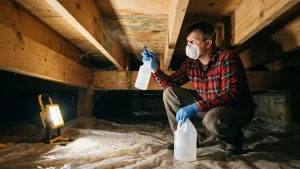
If you’ve spotted mold in your home or building, you’re probably standing in front of it right now asking yourself one question: Can I just clean this myself, or do I need to call someone?
It’s a fair question, and the honest answer is: it depends. Some mold situations are genuinely small enough to handle on your own. Many are not — and the ones that aren’t have a way of looking deceptively simple. At Prime Aire Mold Services, we’ve walked into countless homes across the five boroughs, Long Island, and Westchester where a well-intentioned property owner tried to handle mold themselves, only to end up spending far more time and money than if they’d called a professional from the start.
This guide breaks down exactly where the line falls between a reasonable DIY job and a situation that demands a licensed professional — including what New York State law actually requires. By the end, you’ll know how to make the right call for your property, your wallet, and your health.

First, Understand What Mold Really Is
Mold isn’t a stain. It’s a living organism, and that distinction is the single most important thing to understand before you grab a spray bottle and a sponge.
Surface mold — the fuzzy or discolored growth you can see — is only part of the problem. Mold grows because there is a moisture source feeding it. Spores are microscopic and travel through the air, settling and growing anywhere conditions are damp. So when you see mold on a wall, what you’re really looking at is evidence of a moisture problem, and quite possibly the visible tip of something larger growing where you can’t see it: behind drywall, under flooring, inside wall cavities, or within your HVAC system.
This is why “cleaning the mold” and “solving the mold problem” are two completely different things. You can scrub a surface until it looks spotless and still have an active, growing colony — because the moisture that created it is still there, and so are the spores.
The 10-Square-Foot Rule: Where DIY Ends and Professional Work Begins
Here’s the clearest dividing line we can give you, and it happens to be backed by both common sense and New York law.
If the affected area is 10 square feet or smaller, a homeowner or inexperienced person can typically handle it themselves. At that size, the health risk is comparatively low, and the scope of the work is manageable. Think of a small patch of mold on a bathroom ceiling or a contained spot near a window — situations where the growth is limited and easy to access.
Once you’re dealing with more than 10 square feet, the equation changes entirely. A larger area means more spores, more health risk to anyone in the space, and a much greater chance that the problem extends beyond what you can see. This is the point where professional remediation becomes the responsible choice — and in many New York buildings, the legally required one.
That 10-square-foot threshold isn’t an arbitrary number we invented. It’s written directly into New York State’s mold regulations, which we’ll cover in detail below.
It’s Not Just the Size — It’s the Surface
Square footage is one factor. The material the mold is growing on is just as important, and it’s something most DIYers don’t think about.
There’s a critical difference between non-porous and porous surfaces:
- Non-porous surfaces — like glass, metal, sealed tile, or hard plastic — don’t absorb moisture. Mold sits on the surface and can often be cleaned off effectively, because it never penetrated the material.
- Porous surfaces — like Sheetrock (drywall), wood, drywall paper, insulation, carpet, and ceiling tiles — are a different story entirely. These materials absorb moisture, which means mold doesn’t just sit on top of them. It grows into them. The roots, called hyphae, penetrate the material itself.
This is exactly where so much DIY mold removal goes wrong. Someone sees mold on a section of drywall, wipes the surface clean, and assumes the job is done. But you cannot clean mold out of porous material — you can only clean it off the surface. The mold inside the drywall or wood remains, and within weeks it’s visible again, often worse than before.
When mold is growing on porous building materials like Sheetrock or wood, surface cleaning is not a solution. Those materials usually need to be properly removed and replaced — and doing that correctly, without spreading spores throughout the rest of the home, is a job for a professional with the right containment equipment.
The Mistake That Costs Homeowners the Most: Ignoring the Moisture Source
If we could put one message on a billboard for every New York property owner, it would be this: mold is a moisture problem, not a cleaning problem.
The single biggest thing DIYers get wrong is that they treat the visible mold and never resolve the moisture source. They don’t get to the root of the issue. And without fixing the root cause, the mold always comes back.
We see it constantly. Someone spends a weekend scrubbing and treating a moldy area, feels good about it, and then a month later the exact same spot is growing again. They didn’t fail because they scrubbed wrong — they failed because there was a leaking pipe behind the wall, a foundation seepage issue in the basement, poor ventilation in the bathroom, or condensation from an aging steam radiator system. The mold was just the symptom.
A real remediation process always starts by identifying why the mold is there in the first place. Is it a plumbing leak? Roof intrusion? A humidity problem? Groundwater in the basement? Until that source is found and corrected, any cleaning you do is temporary at best. This is one of the most valuable things a professional brings to the table: the experience and tools to diagnose the actual cause, not just the visible result.
Related: How Much Does Basement Mold Remediation Cost?
The Hidden Costs of DIY Mold Removal
A lot of people choose DIY because they assume it will save money. In our experience, it frequently does the opposite. Here’s how the costs add up in ways most people don’t anticipate.
You may have to do the work twice. As we covered, if you don’t resolve the moisture source or you only surface-clean porous material, the mold returns. Now you’re either redoing the entire job yourself or — more commonly — calling a professional anyway. At that point you’ve paid in time and materials for work that has to be completely redone.
The contractor’s cost can be higher after a failed DIY attempt. When mold has been left to keep growing, or when an incomplete job has spread spores into new areas, the professional remediation that follows is often larger and more involved than it would have been if you’d called at the start.
Moving and re-moving your belongings. This is a cost almost nobody factors in. Before remediation, personal belongings have to be removed from the work area. After remediation, they have to be brought back. When property owners do this themselves and then have to redo the job, they’re handling — and sometimes paying movers to handle — their furniture and possessions twice. We’ve seen people pay for movers, clear out a room, attempt the work, fail, and then pay for movers all over again when the professionals come in. The actual, total cost ends up far higher than if the job had been done right the first time.
When you add it all up — repeated labor, replacement materials, moving expenses, and the larger remediation that often follows a failed attempt — “saving money” with DIY frequently turns into spending considerably more.
What New York State Law Actually Requires
This is where New York property owners — especially landlords, property managers, and co-op owners — need to pay close attention, because mold isn’t only a practical issue here. It’s a legal one.
New York State’s Article 32 of the Labor Law governs professional mold work. The core requirement is straightforward: if a mold project involves more than 10 square feet, it must be handled by professionals licensed by the New York State Department of Labor.
There’s an important wrinkle that’s designed to protect property owners from fraud: the mold assessor and the mold remediator must be separate, independent parties — they cannot be the same company. A licensed assessor inspects the property, identifies the problem, and writes a formal remediation work plan specifying exactly what needs to be done. A separate licensed remediation contractor then carries out that plan. The remediator cannot perform their own final clearance — that, again, falls to the independent assessor. This separation ensures nobody is grading their own homework.
For landlords and building owners in New York City, the rules are even more stringent. Under Local Law 55 (the Asthma-Free Housing Act) and related regulations, owners of buildings with multiple apartments are generally prohibited from remediating mold over 10 square feet themselves. They are legally required to hire licensed third-party professionals, and licensed contractors must file the proper paperwork with the NYC Department of Environmental Protection before work begins. Landlords are also obligated to keep units free of mold, address the underlying moisture cause, and respond to tenant complaints — and simply painting over or wiping away mold does not satisfy the law.
For a homeowner with a small spot of mold in a single-family house, these licensing requirements may not legally apply. But for anyone managing a covered building, attempting DIY mold work over 10 square feet isn’t just risky — it can result in violations and fines. If you own or manage rental property in New York, this is not an area to gamble with.
What a Professional Actually Does That DIY Can’t
When people picture mold removal, they often imagine spraying a chemical and wiping. Professional remediation is a far more controlled process, and understanding what’s involved makes it clear why larger jobs shouldn’t be done by hand.
A proper remediation typically includes:
- Identifying and addressing the moisture source so the problem doesn’t return.
- Containment — sealing off the work area with plastic barriers so spores don’t spread to clean parts of the home during removal. This is one of the biggest risks of DIY: disturbing mold without containment can spread spores throughout the entire property and into the HVAC system, turning a small problem into a building-wide one.
- Negative air pressure and HEPA air filtration to capture airborne spores and keep them from migrating.
- Safe removal and disposal of contaminated porous materials like drywall and insulation, rather than ineffective surface cleaning.
- Proper personal protective equipment, because disturbing mold releases enormous quantities of spores into the air — a genuine health hazard at larger scales.
- Post-remediation clearance, an independent verification that the area is actually clean and safe.
This combination of containment, filtration, source correction, and verification is simply not something a homeowner can replicate with store-bought products. It’s the difference between making mold look gone and making sure it’s actually gone — and that it stays gone.
So, Should You DIY or Hire a Professional?
Here’s the simple framework we’d give any New York property owner:
You can reasonably consider DIY if: the affected area is 10 square feet or smaller, the mold is on a non-porous surface like tile or glass, you’ve identified and fixed the moisture source, and no one in the home has respiratory issues or a compromised immune system.
You should call a professional if: the area is larger than 10 square feet, the mold is on porous materials like Sheetrock or wood, you can’t find or fix the moisture source, the mold keeps coming back, you suspect hidden growth behind walls or in the HVAC system, or you own or manage a building subject to New York’s mold laws.
When in doubt, a professional inspection costs you nothing close to what a failed DIY job and a do-over will. Catching the problem early and handling it correctly the first time is almost always the most affordable path in the end.
Frequently Asked Questions
Does bleach kill mold? Bleach can lighten the appearance of mold on hard, non-porous surfaces, which is why people assume it works. But on porous materials like wood and drywall, it doesn’t reach the roots growing inside the material — and it does nothing to address the moisture source feeding the mold. The result is mold that looks gone for a short while and then returns. Removing the affected material and fixing the moisture problem is what actually solves it.
How do I know if there’s hidden mold behind my walls? Common warning signs include a persistent musty odor, recurring water stains, paint or wallpaper that bubbles or peels, and unexplained allergy or respiratory symptoms that improve when you leave the building. Because confirming and locating hidden mold often requires moisture readings and inspection of wall cavities, this is one of the clearest cases for a professional assessment rather than guesswork.
Will my homeowners insurance cover mold remediation? It depends entirely on your policy and the cause. Many policies cover mold only when it results from a covered “sudden and accidental” event, like a burst pipe, and exclude mold caused by long-term neglect or unresolved leaks. Review your specific policy and document everything with photos before any work begins.
Is a little mold really a health risk? A small, contained patch on a non-porous surface is generally low-risk to clean up. But larger areas release far more spores into the air, which can trigger allergies, asthma, and other respiratory issues — especially in children, the elderly, and anyone with a compromised immune system. The more mold there is, the more reason to let a professional handle it with proper containment.
Related: How Long Does Mold Remediation Take in NYC? (What to Expect)
Talk to Prime Aire Mold Services
Mold is one of those problems that rarely gets better on its own, and almost never gets cheaper by waiting. If you’re not sure whether your situation is a DIY job or one that needs a licensed professional, the smartest first step is simply to ask someone who does this every day.
Prime Aire Mold Services proudly serves homeowners, landlords, property managers, co-op owners, and renters throughout all five boroughs, Long Island, and Westchester. We can help you understand the scope of your mold problem, find the moisture source behind it, and make sure the job is done right — and done once.