TL;DR
Here’s how to check for mold in your home: look for stains and discoloration, smell for a musty odor, and use a moisture meter to find hidden dampness. DIY kits can capture spores or sample a surface, which you can send to a lab for testing. Call a mold professional if mold is hidden, symptoms persist, or you need the species named.
This guide shows you how and where to check for mold the way Prime Aire’s inspectors do it in the five boroughs, Westchester County, Nassau County, and North New Jersey. The method comes from 20+ years in the field and more than 8,000 completed projects. You’ll learn where mold hides and when a DIY check isn’t enough.
Key Takeaways
- Check each room by sight and smell first, then test any stained or soft wall with a moisture meter.
- The EPA says a moldy patch under about 10 square feet is usually safe to clean yourself. For patches over 10 square feet, get professional mold testing done. In New York State, anyone you hire for a larger area must hold a state mold license.
- Color won’t tell you if mold is dangerous. The CDC says to treat black mold like any other mold, and only a lab can identify the species.
- Don’t cut into a wall you suspect has mold. Opening it without containment can release spores through your home.
- Dry any leak within 24 to 48 hours. The EPA says wet materials dried in that window usually won’t grow mold.
- Fixing the water source is what stops mold from coming back. Mold won’t die on its own, and cleaning alone won’t fix the problem.
What You Need Before You Start
Disturbing a mold colony can release spores into the air, so put on protective gear before you open a single cabinet. The EPA’s guide for homeowners recommends:
- An N-95 respirator
- Long gloves made of nitrile, rubber, or neoprene
- Goggles without ventilation holes, so spores can’t reach your eyes
You’ll also want:
- A flashlight or headlamp
- A moisture meter (optional, but useful for the wall check)
- Your phone, to photograph and note everything you find
How to Check for Mold in a House: Room by Room
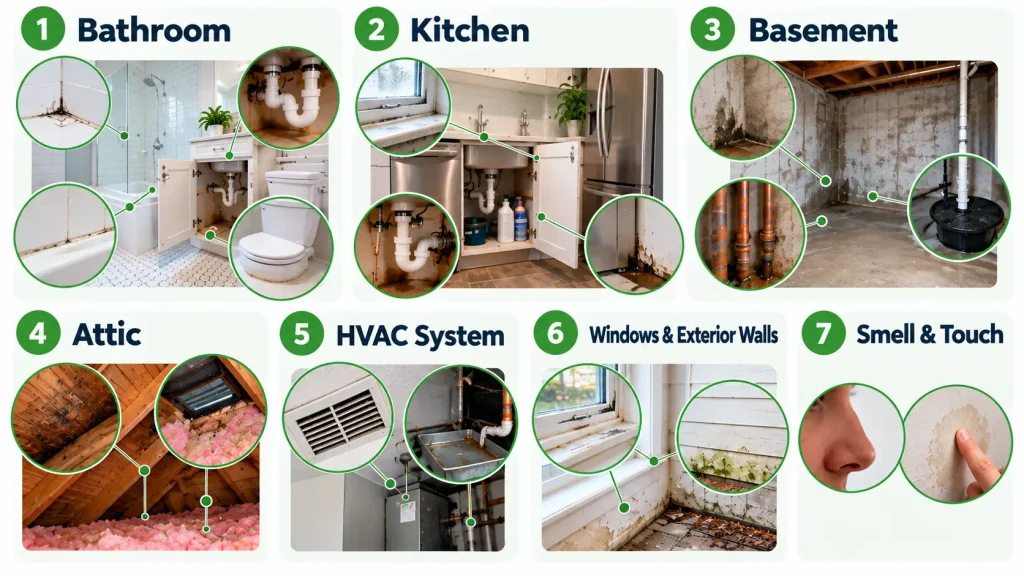
Dampness or mold shows up in about 47% of U.S. homes, according to a Lawrence Berkeley National Laboratory and EPA analysis. Here’s how to check your home for mold, in the order our certified inspectors use. At each stop, look behind furniture and inside cabinets.
- Bathroom: Check grout lines, caulk, under the sink, around the toilet base, and the edges of the tub or shower surround.
- Kitchen: Look under the sink, behind the dishwasher and refrigerator, and along window sills where condensation collects.
- Basement: Walk the perimeter. Check where walls meet the floor, around exposed pipes, and near the sump pump.
- Attic: Look at the roof sheathing and insulation, especially near vents.
- HVAC system: Check registers and the drip pan by the air handler. If you suspect mold in the system, turn it off. The EPA warns that running a contaminated system can spread mold through the building.
- Windows and exterior walls: Look for water stains, bubbling or peeling paint, and dark spots along the bottom of outside walls.
- Smell and touch: A damp, earthy odor that lingers after you air out a room is an early warning sign. Press on drywall near any stain. A soft or spongy spot means moisture is behind the surface.
NIOSH, the CDC’s workplace safety institute, has found that careful visual checks and musty odors are reliable signs of a mold problem. Our guide on what mold smells like explains what to sniff for.
How to Detect Mold Inside Walls
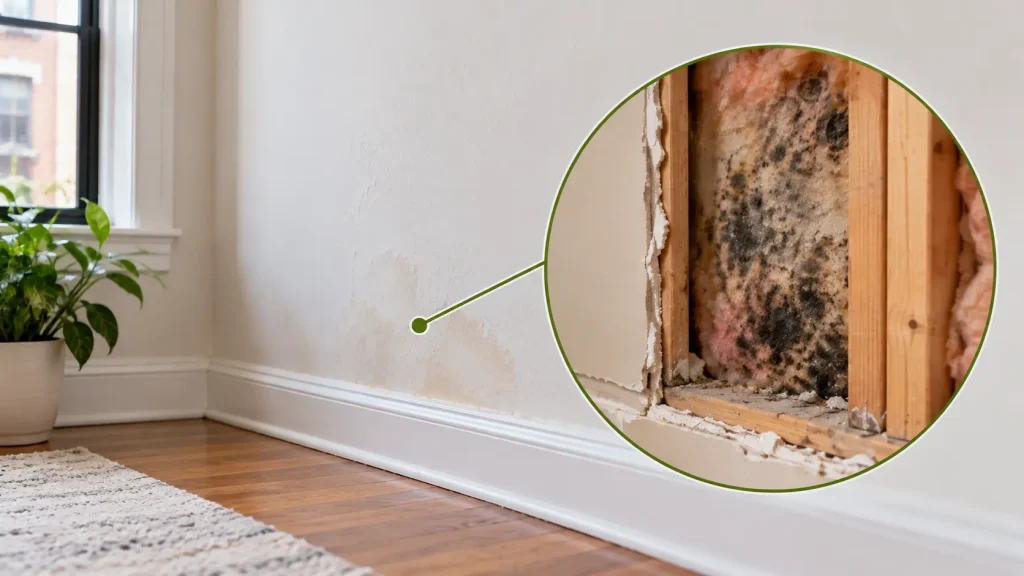
Hidden mold usually leaves surface clues first. Check in this order:
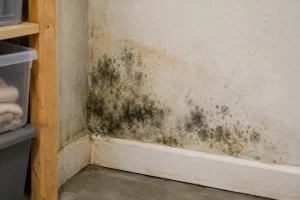
- Look at the wall. Discoloration, dark water rings, peeling or bubbling paint, and warped drywall all point to moisture behind the surface. Focus on walls near past leaks, plumbing, or flooding.
- Follow your nose. A musty smell that won’t clear is often the first sign of hidden growth. Sniff near outlets, baseboard gaps, and wall vents, where air from inside the wall escapes.
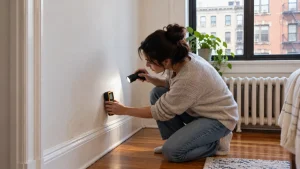
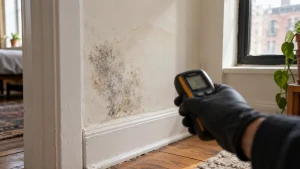
- Use a moisture meter. Take readings along the stained area, then on a dry section of the same wall. A clearly higher reading marks a problem zone.
- Stop before you cut. If you find high readings and a musty smell together, book a mold inspection. The EPA warns that disturbing hidden mold can release a burst of spores into your home.
An inspector can confirm what’s inside without tearing out drywall. Thermal imaging shows damp areas behind the wall, and a fiber optic borescope can view the cavity through a pen-sized hole. Prime Aire includes thermal imaging with every inspection at no extra cost.
How to Detect Mold in the Air
To test for mold in the air, air sampling DIY kits use an open dish that catches spores as they settle:
- Close the room’s windows and doors, and follow the kit’s directions for prep time.
- Set the open dish at table height in the middle of the room for the time the kit specifies.
- Seal and label the dish, then mail it to the kit’s lab or read it as directed.
Expect some growth on the dish. The CDC notes that no indoor space is completely free of mold spores, and a home kit has no outdoor sample to compare against.
A professional test fixes that gap. The inspector uses a pump to draw air samples indoors and outdoors, and an accredited lab compares the two. Inspectors also pair air samples with thermal imaging and moisture readings to trace the water source behind the growth.
How to Check for Black Mold
You can’t confirm black mold by looking at it. A mold’s color doesn’t tell you how dangerous it is. Treat molds that can produce toxins, like Stachybotrys chartarum, the same as any other mold.
If black mold is your worry:
- Start with rooms that have had leaks or flooding. Stachybotrys grows on materials like drywall, paper, and wood that stay wet for a long time.
- Look for dark, slimy, or greenish-black patches in damp, poorly lit areas with a strong musty smell.
- Check the surrounding wall with your moisture meter.
- If you need the species named for a lease dispute or a home sale, have a professional take samples for lab analysis. A lab is the only way to identify the species.
For a small patch on a hard surface like tile, the EPA recommends scrubbing the mold off with detergent and water, then drying the area completely. Mold larger than that, or mold inside a wall, is a job for a professional.
When a DIY Check Isn’t Enough
A DIY approach is reasonable when:
- The mold is on the surface and covers less than about 10 square feet
- It’s nowhere near the HVAC system or ductwork
- The water involved was clean, not sewage
Call a professional when:
- Mold covers more than 10 square feet. In New York State, the assessor and the remediation contractor you hire must both be licensed by the Department of Labor.
- You suspect mold inside walls or the HVAC system
- Someone at home has asthma, allergies, or a weakened immune system
- Mold came back after an earlier cleanup
- The home recently had flooding or a sewage backup

Berkeley Lab and EPA research estimated that about 4.6 million U.S. asthma cases are attributable to dampness and mold at home.
The most common mistake is cleaning visible mold without fixing the water source, so the mold grows back. Testing tells you what’s there, and stopping the moisture is what keeps it from returning.
You’ll know the problem is handled when the water problem is fixed, no mold is visible, the musty smell is gone, and the area stays dry on follow-up checks.
Book a Professional Mold Inspection with Prime Aire
A walkthrough and a moisture meter can tell you something is wrong. They can’t name the species, compare indoor spores against outdoor air, or see inside a wall cavity.
Prime Aire Mold Services’ team includes IICRC-certified and EPA-certified technicians, plus New York State-licensed home inspectors. We use infrared thermal imaging cameras, laser particle counters, hygrometers, and fiber optic borescopes to find mold without opening walls.
Your report arrives within 2 to 3 business days. It covers lab results, severity, remediation steps, and prevention, with photos throughout. When we handle the remediation, 95% of our jobs pass clearance testing on the first try.
Professional mold testing in NYC generally costs a few hundred dollars (see our cost guide). Prime Aire’s residential inspection starts at $389 and includes thermal imaging.
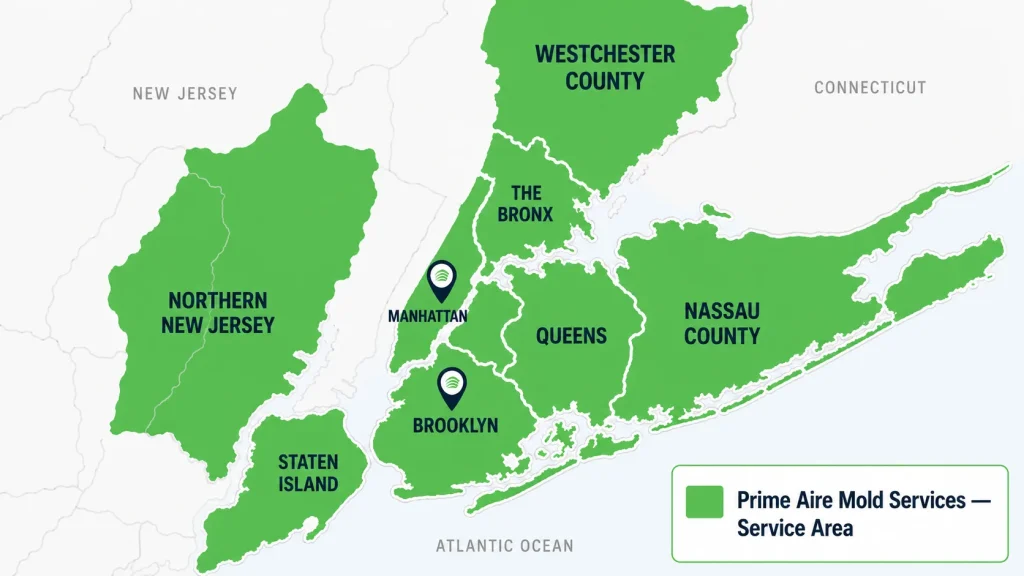
We serve Manhattan, Brooklyn, Queens, the Bronx, and Staten Island, plus Westchester County, Nassau County, and North New Jersey. If your walkthrough turned up anything suspicious, or that musty smell won’t go away, contact Prime Aire before it gets worse.
FAQs
What Does Black Mold Look Like?
Dark green or black patches that often look slimy or sooty, usually with a musty smell. Color alone can’t confirm the species. Only a lab can.
Can Black Mold Grow on Metal?
Not on bare metal. It can grow on dust or grime that builds up on damp metal surfaces.
Can Mold Cause Swollen Lymph Nodes?
It isn’t a typical mold symptom. See a doctor if the swelling lasts more than two weeks.
How Much Mold in a Crawl Space Is Acceptable?
None. There’s no federal safe limit, and any visible growth means there’s a moisture problem to fix.
How to Detect Mold in Carpet
Look for a musty smell, dark spots, or padding that stays damp. Lift a corner and check the pad underneath, since mold often grows there first.
How to Remove Mold From a Bathroom Ceiling
For patches under 10 square feet, wear an N-95, gloves, and goggles, then scrub with detergent and water and dry the area. Replace drywall that’s soaked or keeps growing mold back. For patches over 10 square feet, call Prime Aire.
Will Vinegar Kill Mold?
It can kill some mold on hard surfaces like tile. It won’t reach mold growing inside porous materials like drywall.