Attic mold is sneaky. It grows in a space you almost never go into, it’s usually well established before anyone notices, and by the time you catch a musty smell downstairs, it has often spread much further than you’d guess. After more than 10,000 assessments across New York, I can tell you the attic is one of the most common places I find mold, and one of the most misunderstood. This is what really causes it, where it hides, and, most importantly, when it’s time to stop watching and call a professional.
Call a professional the moment you find attic mold with no obvious leak nearby, mold spreading across the roof sheathing or rafters, or a heavy, musty smell when you open the hatch. Those are signs the real problem is moisture and ventilation, not a single stain, and it needs to be traced and tested before anyone disturbs it.
What actually causes attic mold
Most people picture a big, dramatic roof leak. The truth is more subtle, and understanding it is the difference between fixing the problem and chasing the symptom.

Small roof leaks, and the material that matters
Most attic mold starts with a small roof leak, not a gushing one. But here’s what surprises people: a lot of the older building materials up in these roofs are actually pretty resilient. Because of their age and makeup, they resist mold reasonably well. The trouble shows up in newer construction that puts sheetrock up around the roof. Sheetrock does not belong there. It soaks up moisture and holds it, and that’s exactly where I start seeing serious attic mold take hold.
From Prime Aire Mold Services
A lot of people have this backwards. A small roof leak is usually where it begins, but the older roof materials are surprisingly resistant to mold. What worries me is the newer building that uses sheetrock around the roof. It isn’t recommended, it holds moisture, and that’s where the real problems start.
Ventilation and condensation, the bigger culprit
The larger issue, and the one behind most of the attic jobs I inspect, is ventilation and condensation. When an attic can’t breathe, moisture and humidity accumulate in the space itself. You don’t even need a leak for this. Warm, damp air collects, meets a cold roof deck, condenses, and now you have the perfect conditions for mold, created entirely by air that had nowhere to go. That’s why an attic with a “clean” roof can still be full of mold.
| Resists attic mold | Invites attic mold |
|---|---|
| Older, aged roof materials that shed moisture well | Newer sheetrock installed around the roof |
| Strong cross-ventilation and steady airflow | Poor, blocked, or missing ventilation |
| A dry, well-vented attic space | Trapped humidity and condensation on the deck |
| Vents that exhaust fully outside | A dryer or bathroom vent dumping into the attic |
Why attic mold shows up far from the leak
This is the single most important thing to understand about attic mold, and the reason you can’t just treat the spot you can see. Mold in an attic almost never sits on top of the actual problem.
From Prime Aire Mold Services
Here’s what surprises homeowners the most. A little moisture gets into the roof, it turns into humidity, and that humidity can grow mold dozens or even hundreds of feet away from where the leak actually is.
So the mold you’re staring at is almost never sitting on the source. That’s exactly why you can’t just clean the patch you see. You have to trace the moisture back to where it’s really coming from, and in an attic, that’s usually hiding somewhere else entirely.
This is also why attic mold is a poor do-it-yourself project. Even if you scrub off every visible spot, you’ve done nothing about the humidity or the ventilation failure that produced it, so it comes back, often in a new location. The EPA’s guide to mold warns homeowners about exactly this kind of hidden growth and when a job calls for a professional. Finding the source takes moisture readings, airflow assessment, and knowing how air actually moves through a roof, which is the whole point of a professional inspection.

The attic ventilation problem no one thinks about
If I could hand every homeowner in New York one piece of knowledge, this would be it. Ventilation is the quiet hero of a healthy attic, and its failure is behind an enormous share of the mold and moisture problems I get called to inspect.
From Prime Aire Mold Services
I wish more homeowners understood attic ventilation. Getting it right prevents so many of the problems I’m called for, and not just mold. It protects the whole building envelope. An attic that can’t breathe traps moisture, and trapped moisture is the beginning of almost every attic mold job I’ve ever seen.
The failures are often small and silent. A vent that should exhaust outside gets pointed into the attic instead, and it runs that way for years while nobody’s the wiser. Every use pumps warm, wet air into a closed space, and the humidity climbs.
I had a client whose dryer was venting straight into the attic for years. Every load of laundry was pushing warm, wet air into a sealed space. And the thing is, that was catchable. Within months the attic humidity was already running high, and one simple check would have flagged it long before it ever turned into mold.
That’s the whole case for looking early instead of waiting for the smell.
When to call a professional
Not every spot means an emergency, but there are clear lines where watching turns into acting. Here’s the threshold I’d give my own family.
| Keep an eye on it | Call a professional now |
|---|---|
| A small spot near a leak you already found and fixed, now drying | Mold with no sign of any leak nearby (usually a ventilation problem) |
| A faint, passing smell after one heavy storm | A heavy, lingering musty smell when you open the attic |
| One slightly damp patch of insulation after a single event | Contact mold spreading across the sheathing or rafters |
| Good airflow and a dry, cool attic | Visible condensation, high humidity, or a vent dumping into the space |
Two of those deserve emphasis, because they’re the ones people miss. Mold with no evidence of a leak tells you the cause is airborne moisture, which almost always means a ventilation failure that will keep feeding new growth until it’s corrected. And a heavy smell is not just unpleasant, it’s a signal that spores are active and concentrated. When you notice either one, resist the urge to climb up and start wiping. Disturbing established attic mold sends spores through the air and into the rest of the house, which turns a contained attic problem into a whole-home one.
Where attic mold hides
When I inspect an attic, I already know the usual hiding spots, because moisture and airflow follow predictable paths. The mold rarely announces itself in the middle of the floor where you’d notice it. It gathers in the corners, on the underside of the roof, and in the places air gets trapped.

Notice how many of those spots sit near vents, eaves, and the roof deck, all places tied to airflow and moisture rather than to a single dramatic leak. That’s the pattern that tells an inspector the real story.
What a Prime Aire attic inspection reveals
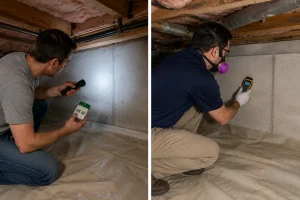
A proper attic inspection is not a flashlight and a guess. When we go up, we’re reading the whole system. A licensed mold inspector performs a full visual and manual assessment, then backs it with tools that see what the eye can’t: moisture meters to find damp materials, infrared cameras to reveal moisture and hidden growth behind and under surfaces, and particle and air sampling to measure what’s actually in the air compared to outside. Samples go to an accredited lab with a documented chain of custody, and you get a clear report that names the moisture source and the steps that fix it.
| What a homeowner notices | What a Prime Aire inspection reveals |
|---|---|
| A stain or patch of mold | The actual moisture source, often far from the visible mold |
| A musty smell upstairs | Humidity and condensation levels measured with moisture meters |
| Maybe a higher energy bill | Ventilation failures and vents discharging into the attic |
| Nothing at all, because it’s hidden | Concealed growth behind or under insulation, found with infrared |
Because New York’s mold law keeps the inspector and the remediator as separate companies, our job is to find the truth of what’s happening in your attic and document it. If the report shows you need professional remediation, you’ll have an independent, tested scope in hand, which is exactly what you want before you hire anyone to do the removal.
Signs you can catch from inside the house
You don’t have to climb into the attic to get the first warning. Most attic mold announces itself downstairs long before anyone goes up to look. Watch for staining on top-floor ceilings, a musty smell that’s strongest in the upstairs rooms, and energy bills that creep up as wet insulation loses its effectiveness. Rising indoor humidity is another quiet tell. If your top floor feels damp or stuffy no matter what you do, the attic above it is worth checking. Catching any of these early is what turns a quick fix into a prevented disaster, and it’s why an attic mold inspection in NYC is worth booking at the first sign rather than the last.

Who you’re getting this from
I read attics the way the building reads them, starting from how water and air move through a structure. That background, plus more than 10,000 assessments across New York City, from Brooklyn to the Bronx, is why I don’t stop at the visible mold. I trace it to the source, measure the moisture and the airflow, and test what’s in the air, so you get the real picture instead of a guess. Whether it’s a mold inspection in Brooklyn, mold testing in the Bronx, or an attic assessment anywhere else in New York City, the goal is the same: find the cause, document it, and tell you honestly whether you need remediation or not.
Frequently asked questions
Book an Attic Mold Inspection
Smell something musty upstairs, or spotted mold in the attic? Prime Aire Mold Services will find the source, test the air, and give you a clear, documented report. We provide mold inspection and testing across New York City, including Brooklyn and the Bronx.